
The problem
Governance can stop too early.
AI governance can still stop before an output becomes a consequential judgement, recommendation, action or decision.
Operational assurance for consequential AI
From AI Generation to Governed Reliance
The answer is not enough. We need to know how the conclusion was constructed and what assurance justifies relying on it.
The operational pathway
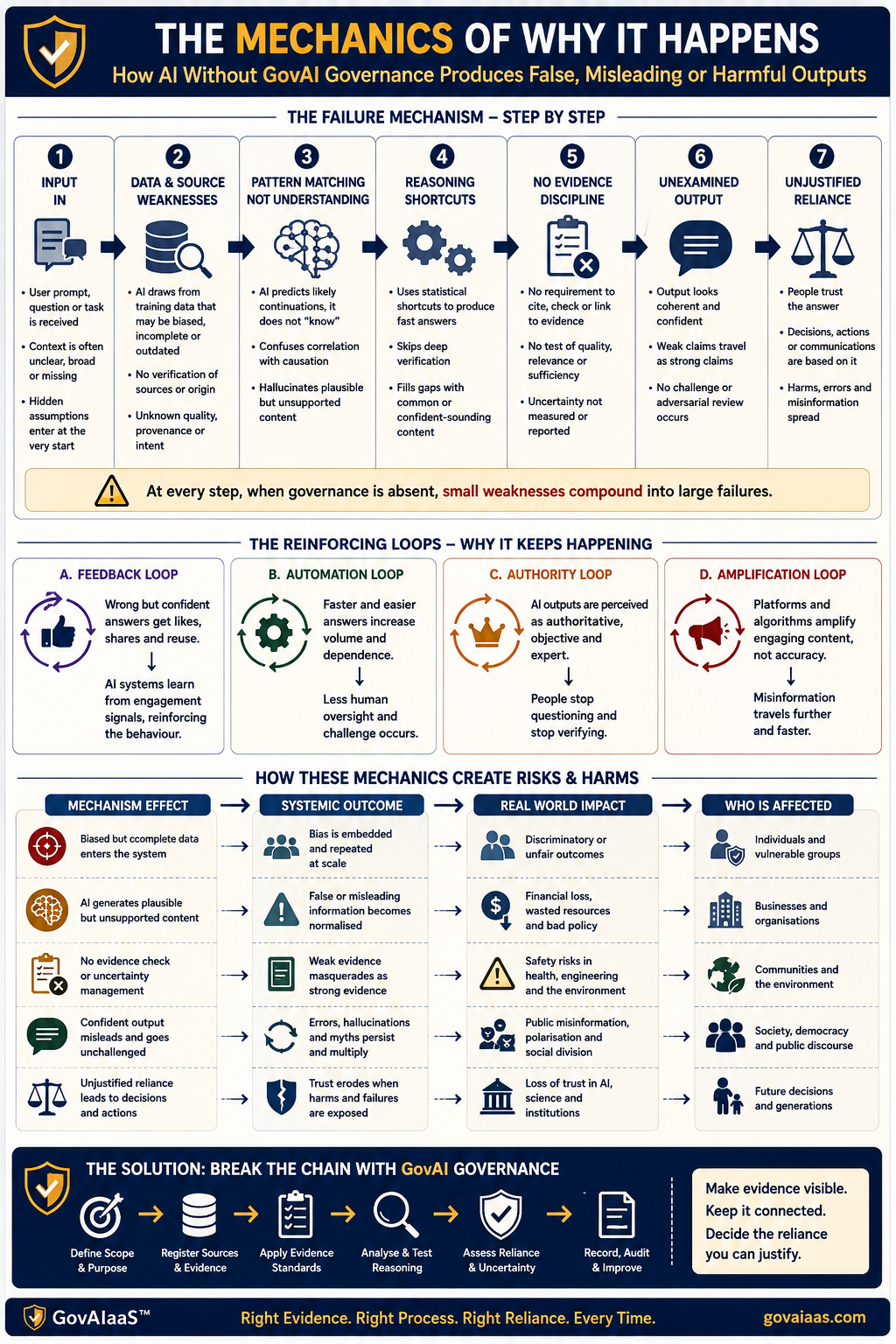
Seven failure points show how small, unmanaged weaknesses can compound. The first six occur on the prompt-to-output pathway; the seventh begins when an output is relied upon.
Input in
An unclear task, missing context or undisclosed assumptions enter before any reasoning begins.
Data & source weaknesses
Incomplete, outdated or provenance-poor sources distort the material available to the model.
Pattern matching, not understanding
Likely continuations can confuse correlation with causation and sound plausible without support.
Reasoning shortcuts
Fast statistical shortcuts skip deep verification and fill evidential gaps with confident content.
No evidence discipline
Claims are not tested for source quality, relevance or sufficiency, and uncertainty is not preserved.
Unexamined output
A coherent answer may carry weak claims forward when challenge, review and adversarial testing are absent.
Unjustified reliance
People treat the output as authoritative, base decisions on it and spread resulting errors or misinformation.
Failure compounds. Without governance, small weaknesses at each step can accumulate into a plausible but false, misleading or harmful output.
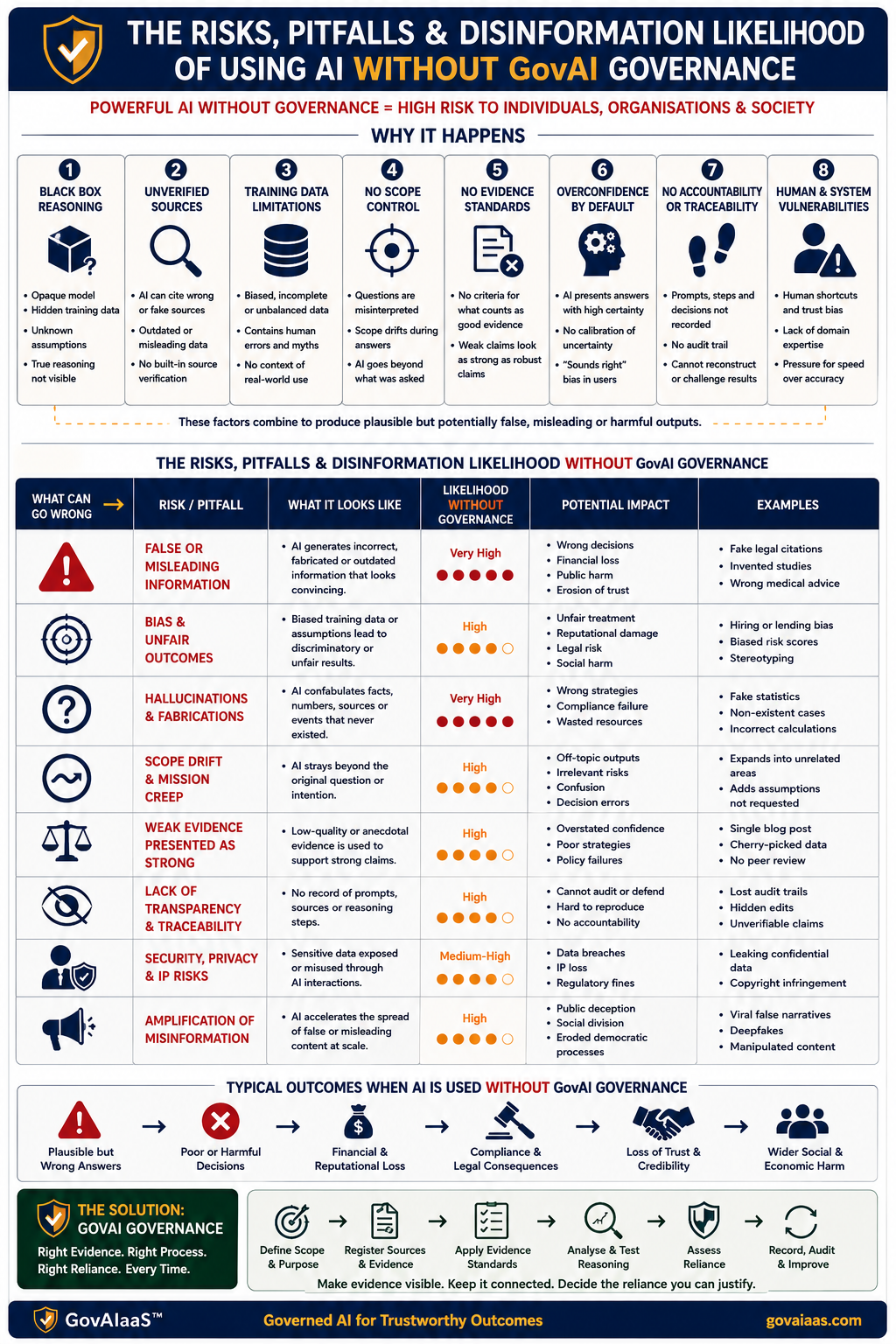
Detailed risk references
Select either artwork to inspect it at full size.
Likelihood labels are qualitative governance indicators derived from the supplied risk framework; they are not statistical probabilities.
The prompt-to-output pathway produces a candidate answer.Risk becomes consequential when assurance fails and that output is allowed to influence a judgement, action or decision.
Governing principle
The bridge from AI generation to governed reliance.
The proposition in three parts
Existing governance, standards, controls and regulation address important parts of the AI lifecycle. Consequential risk can still arise at the transaction and point-of-use level.
The problem
AI governance can still stop before an output becomes a consequential judgement, recommendation, action or decision.
What is needed
Connect runtime evidence to the claims, transformations, uncertainty and review supporting a conclusion.
The governed solution
Control Observe Reconstruct Assure Authorise reliance
The four-set story
The project develops through four stages: identify the problem, define what is missing, establish the governed architecture, then demonstrate it in practice.
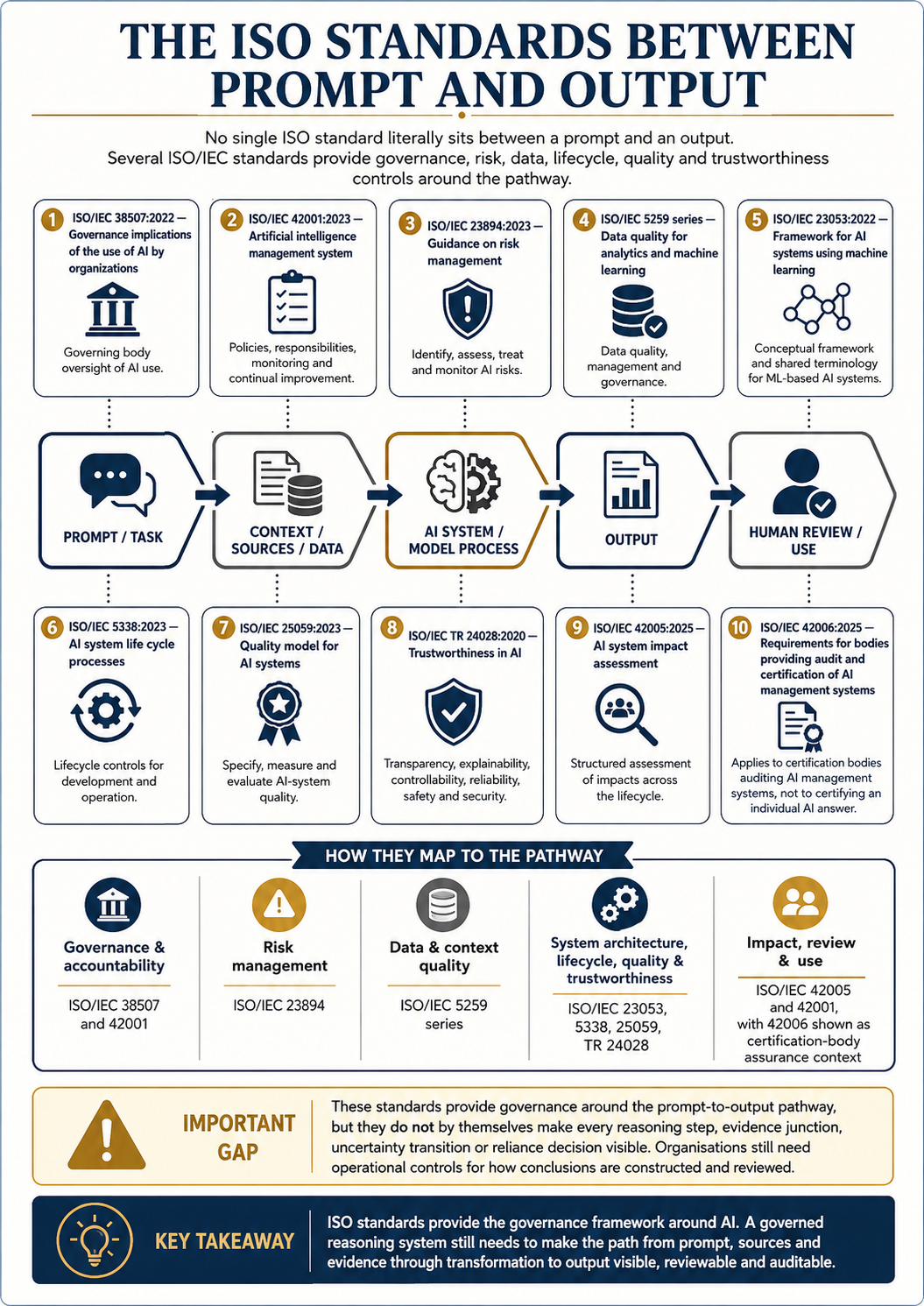 The ISO Standards Between Prompt and Output
 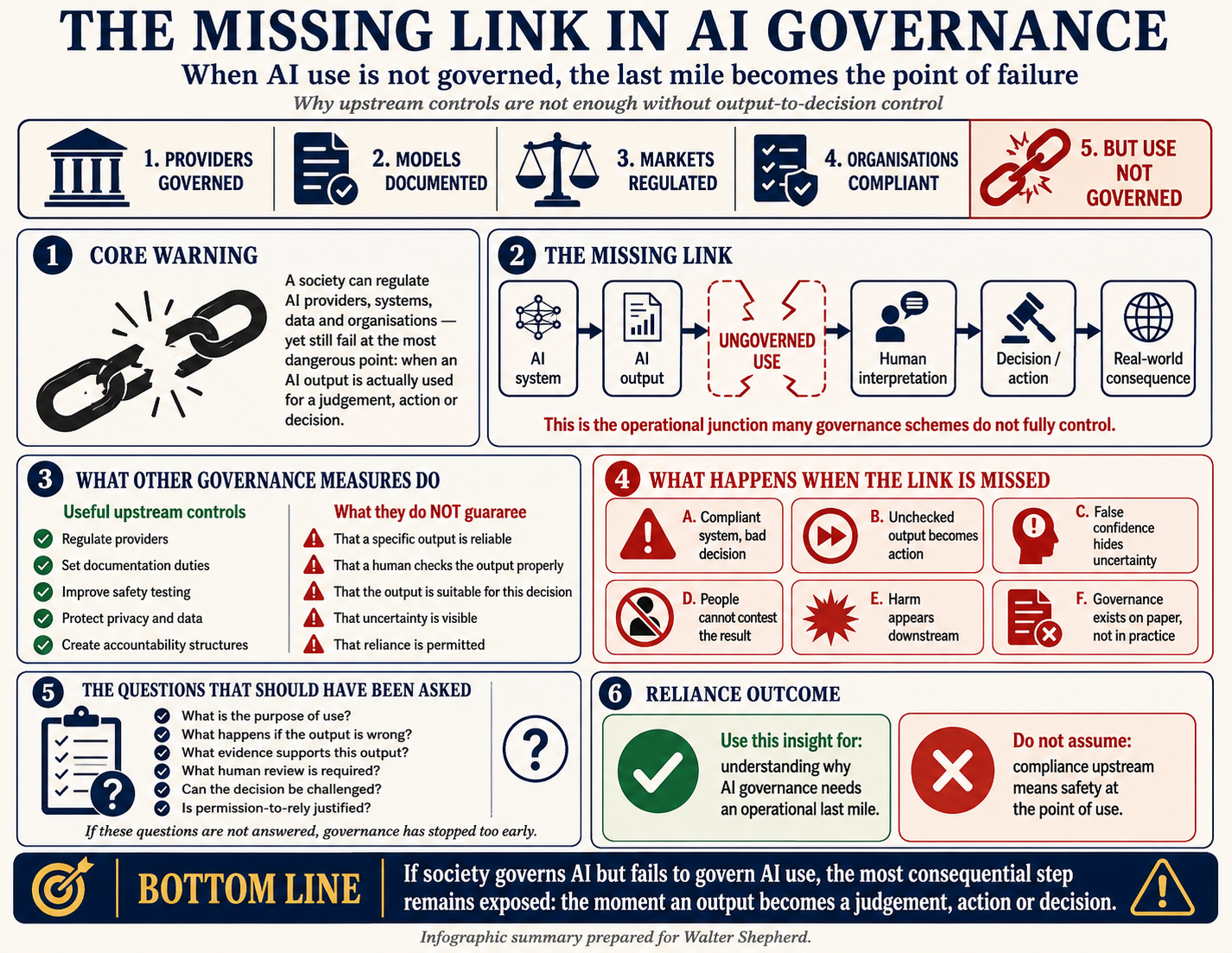 The Missing Link in AI Governance
 Select an artwork to view it at full size.
Set 1
Where governance can stop before an AI output becomes a consequential judgement, recommendation, action or decision.
Explore this stage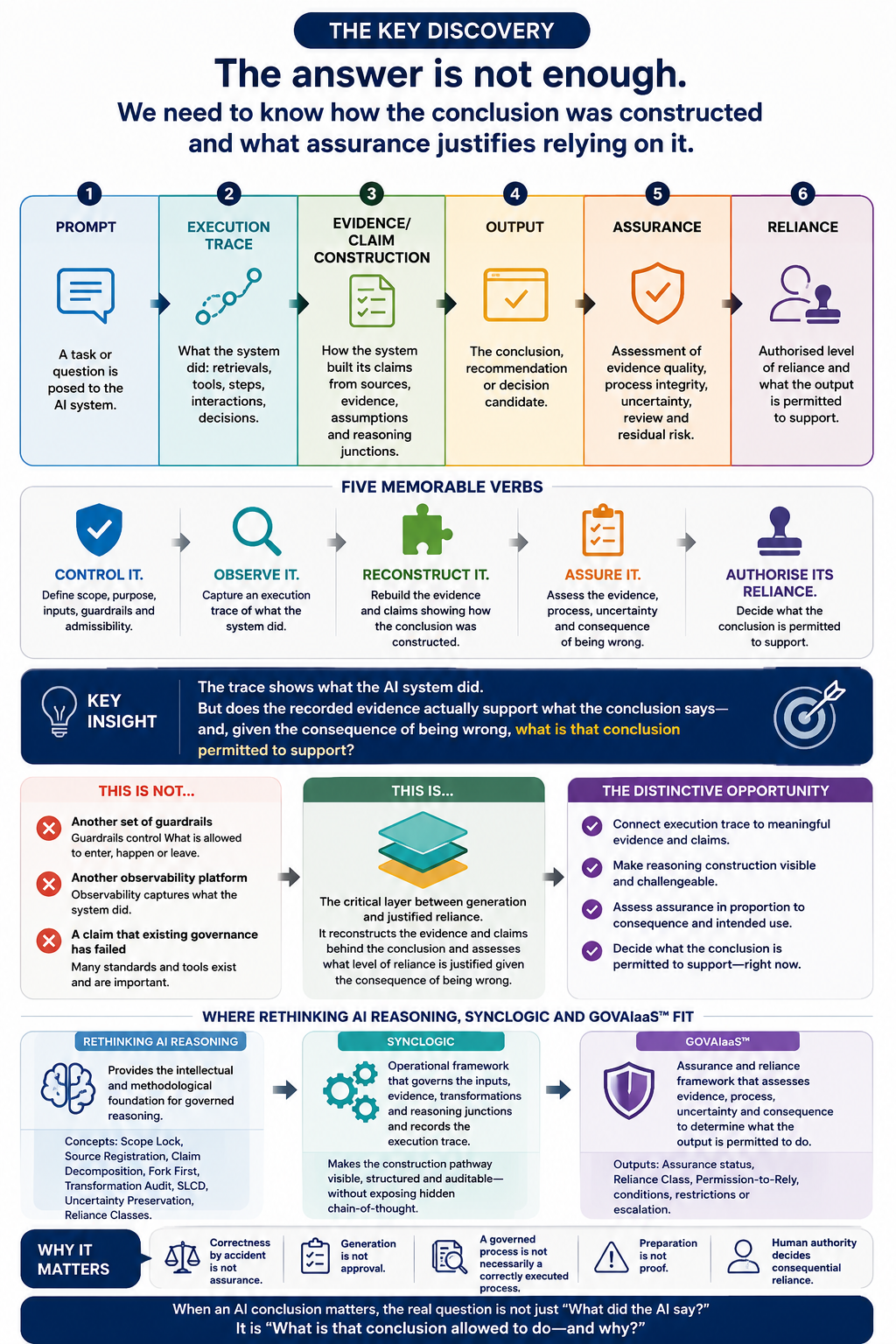 The Key Discovery
  Why AI Needs a Transaction-Level Runtime Record
  Reasoning Traces Can Transfer Capability — But Not Assurance
 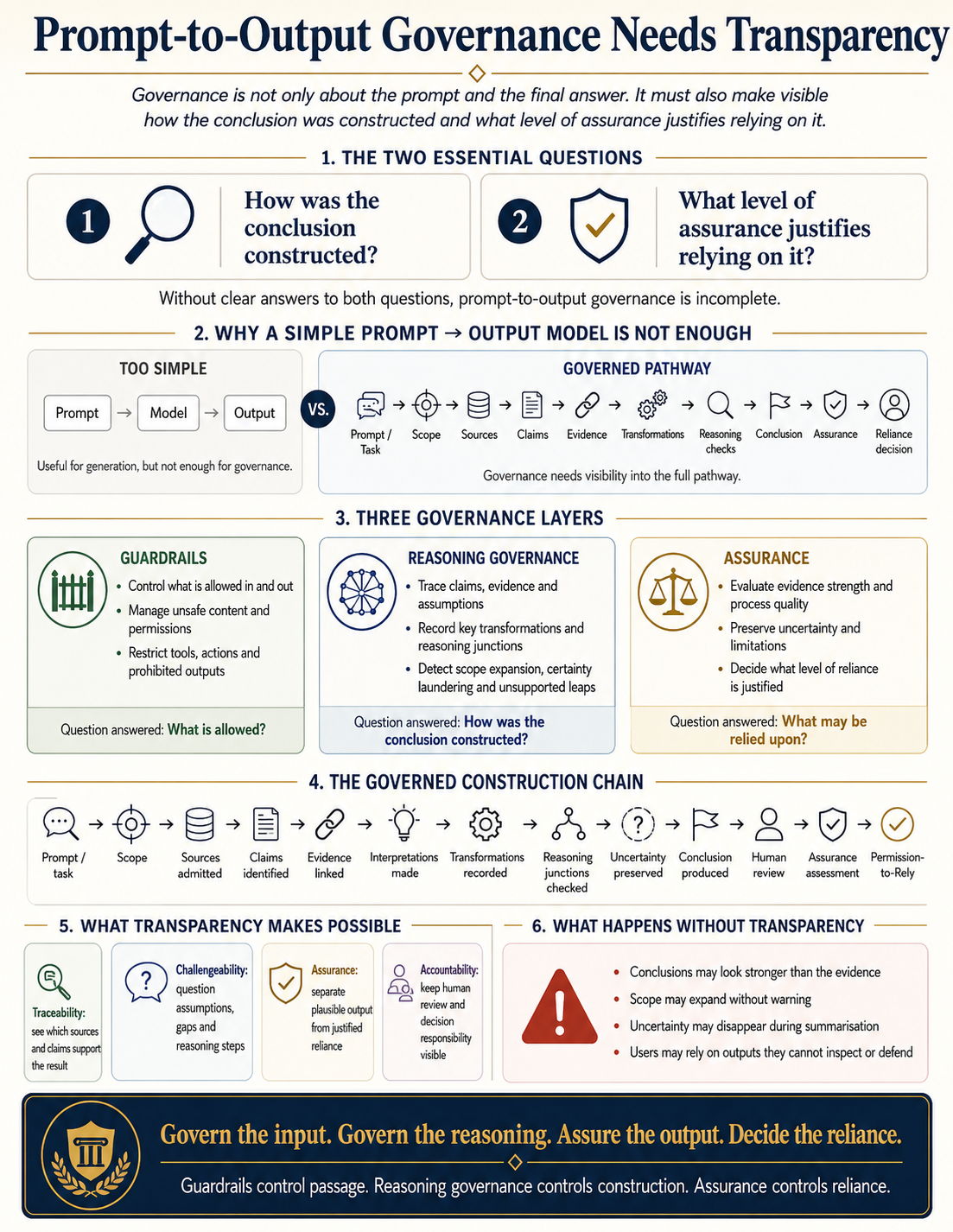 Prompt-to-Output Governance Needs Transparency
 Select an artwork to view it at full size.
Set 2
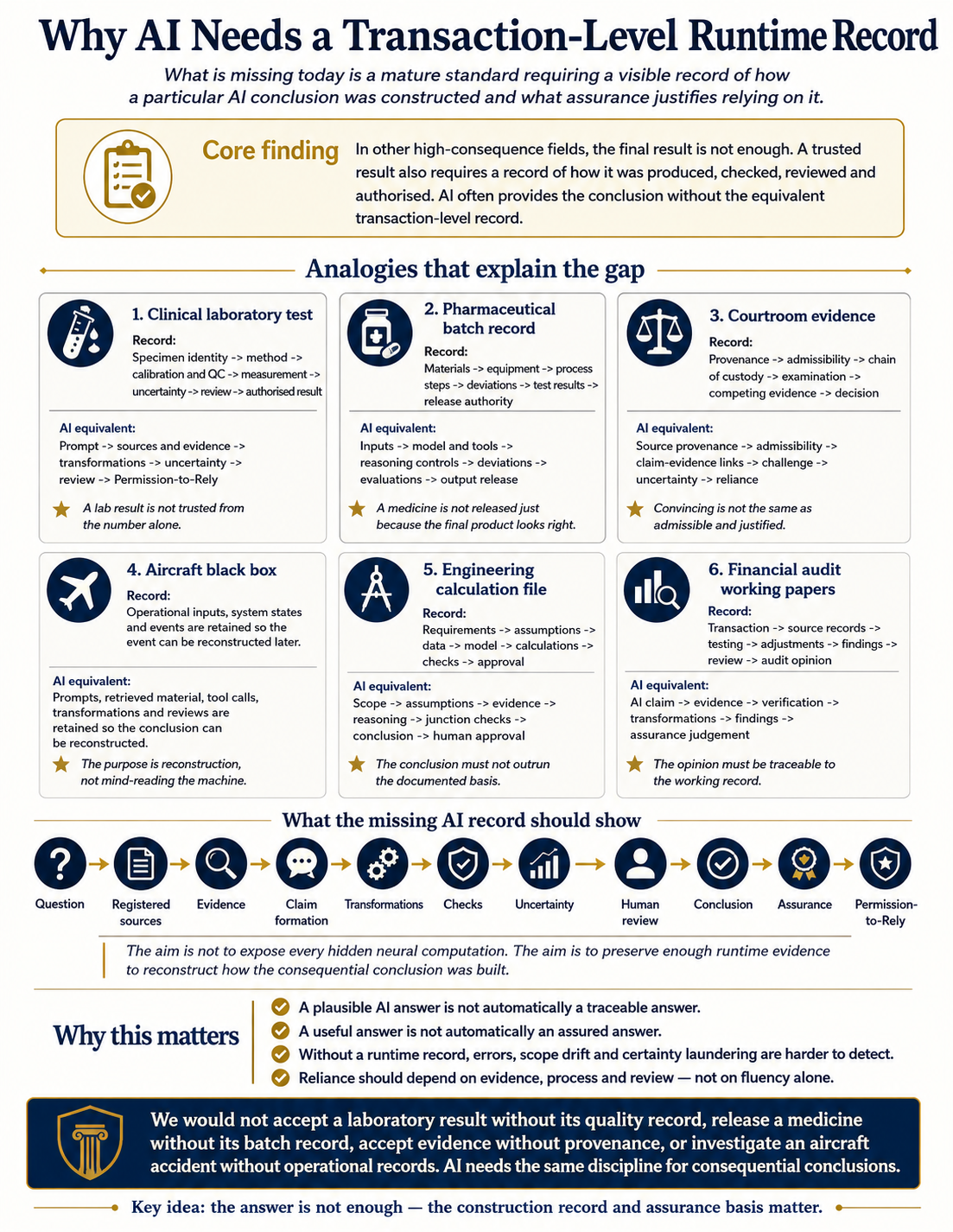
Why consequential AI needs a transaction-level record of evidence, claims, transformations, uncertainty and review.
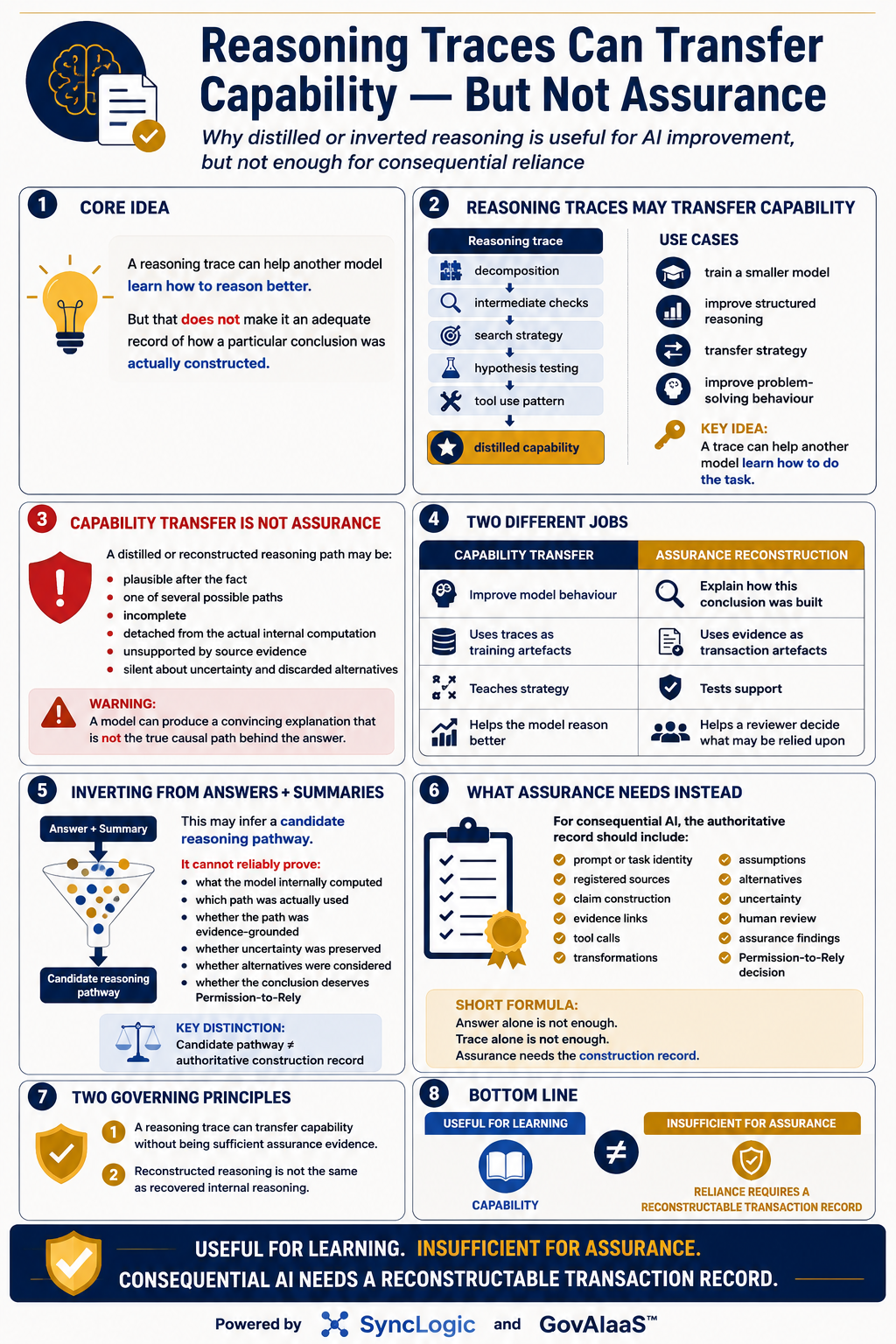
Explore this stage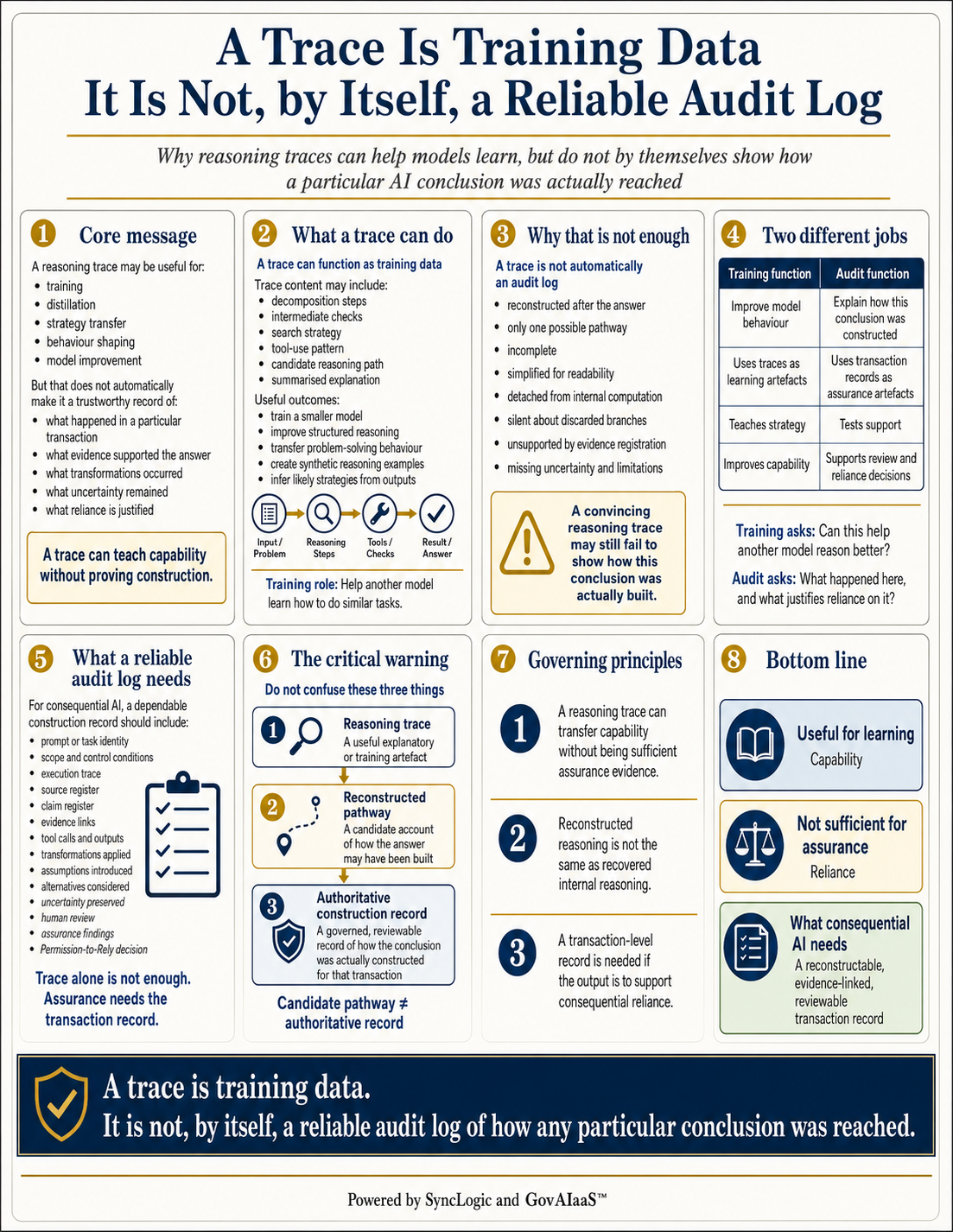 A Trace Is Training Data — Not, by Itself, a Reliable Audit Log
 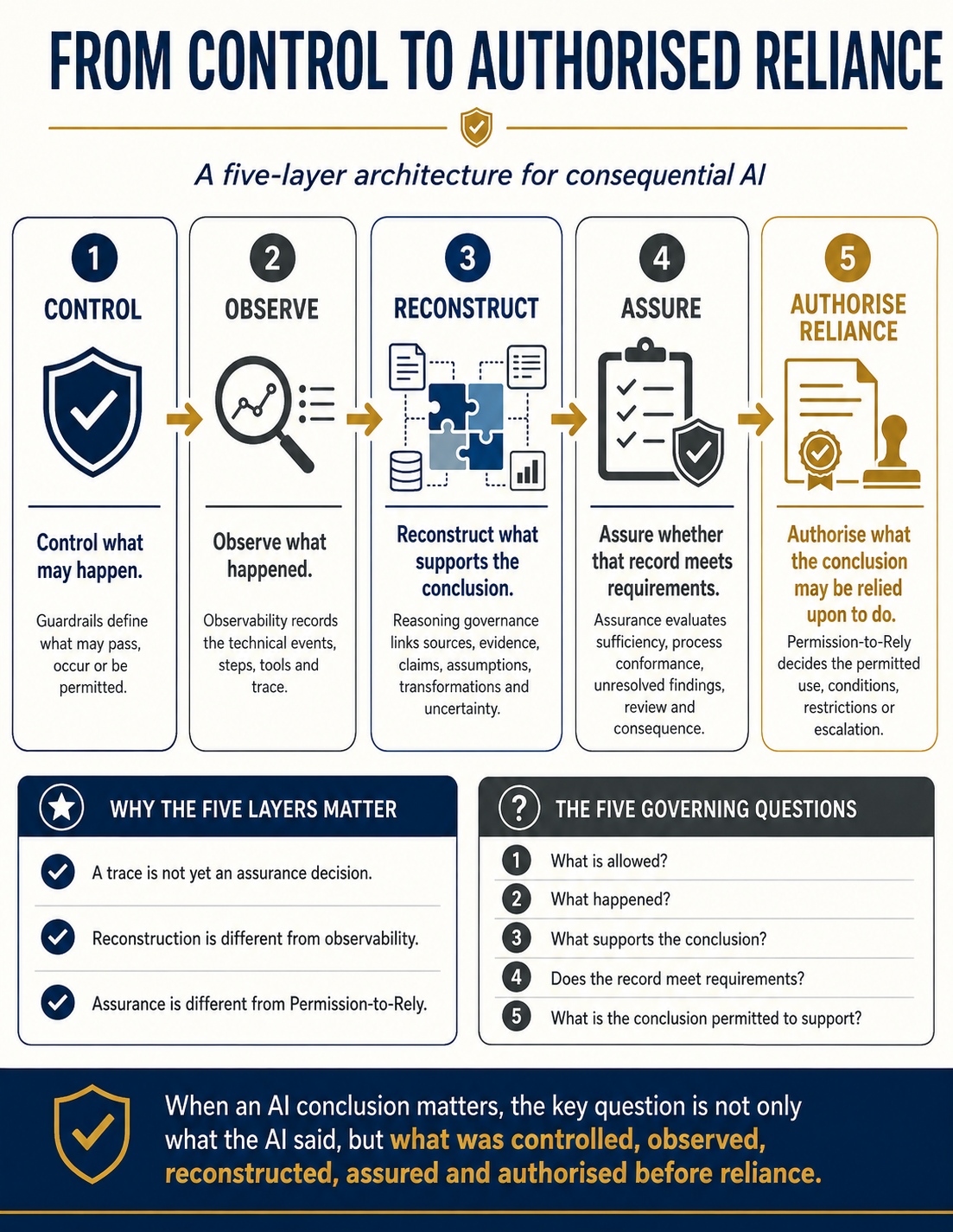 From Control to Authorised Reliance
 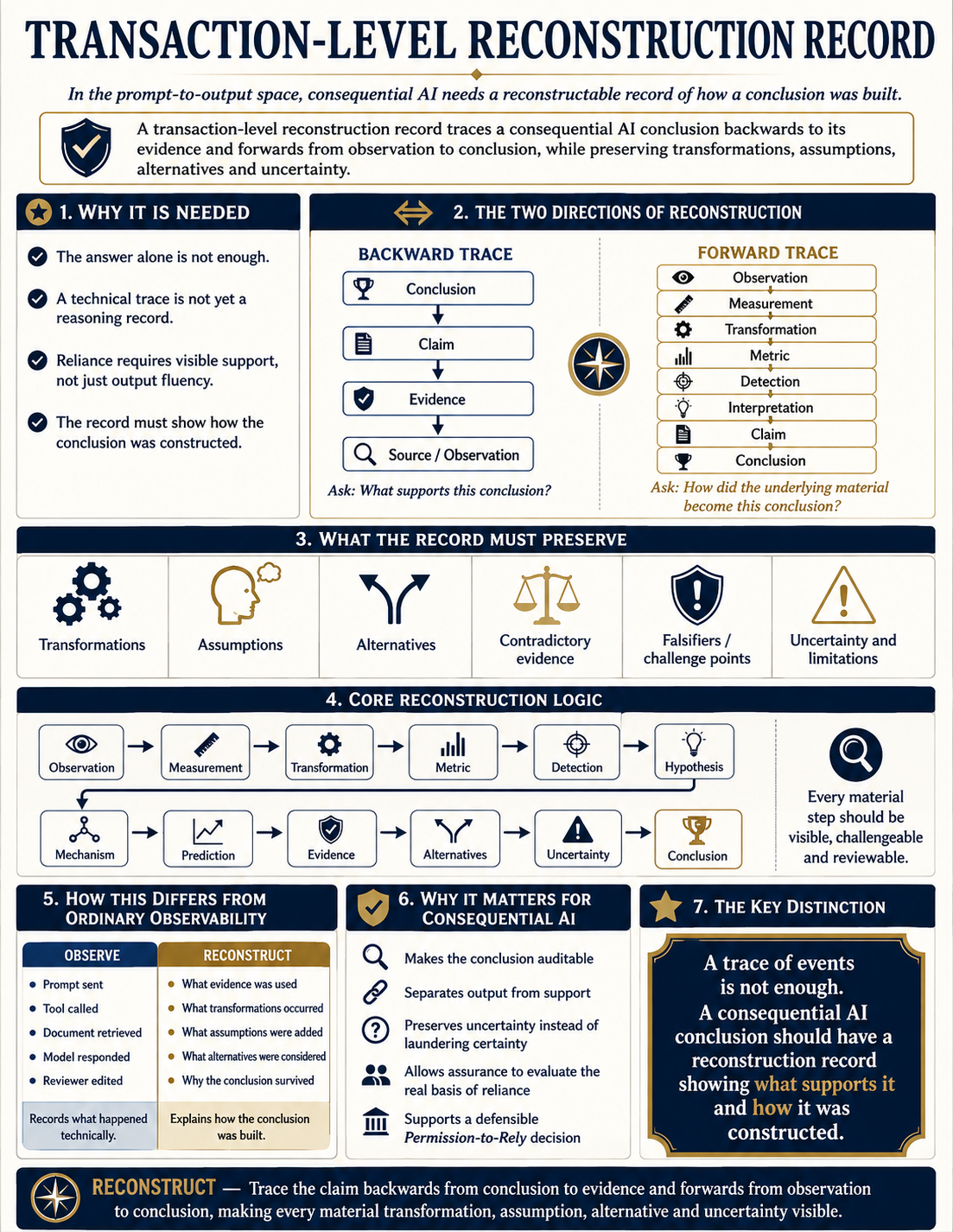 Transaction-Level Reconstruction Record
 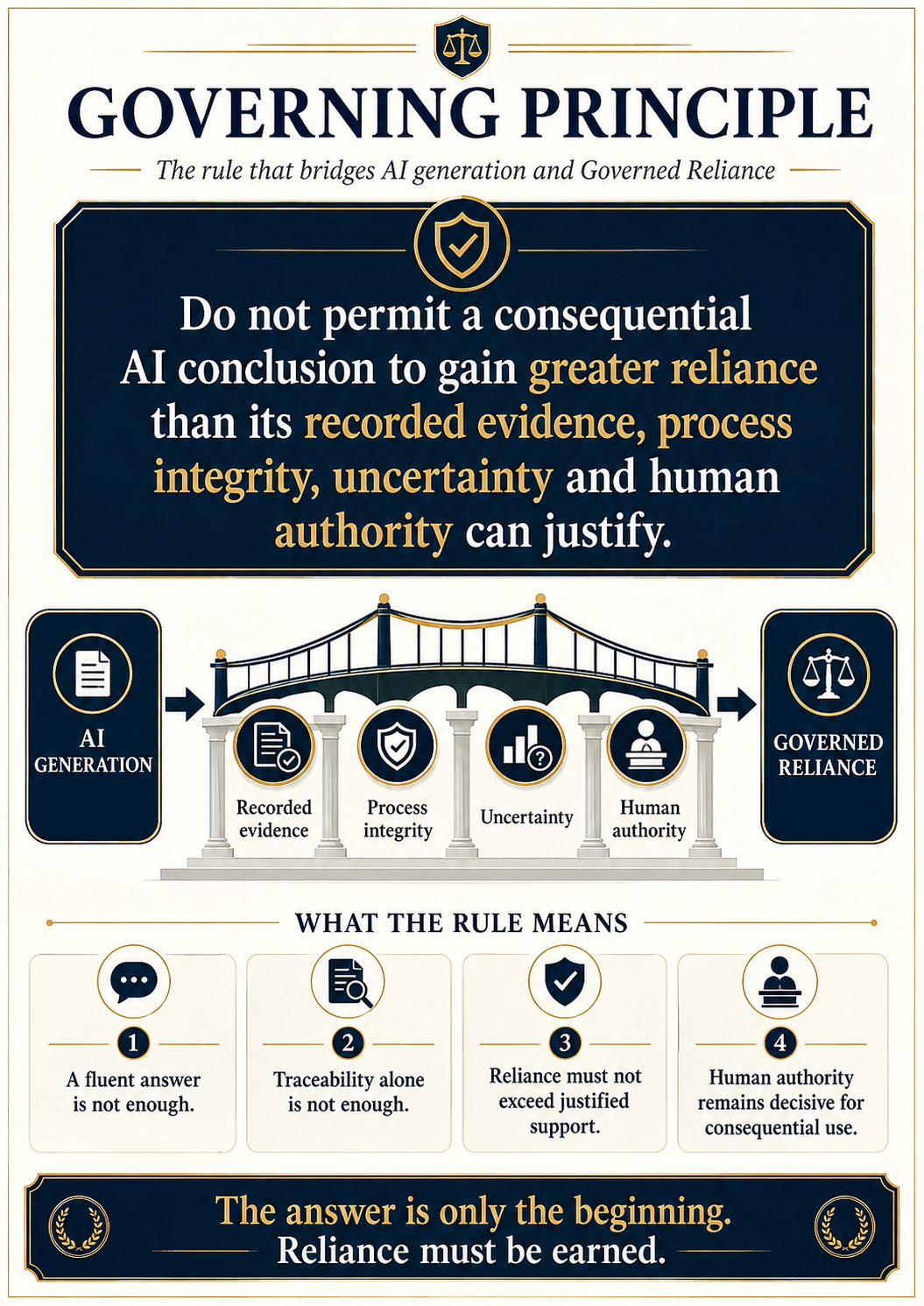 Governing Principle
 Select an artwork to view it at full size.
Set 3
The five-layer architecture from permitted action to authorised reliance.
Explore this stage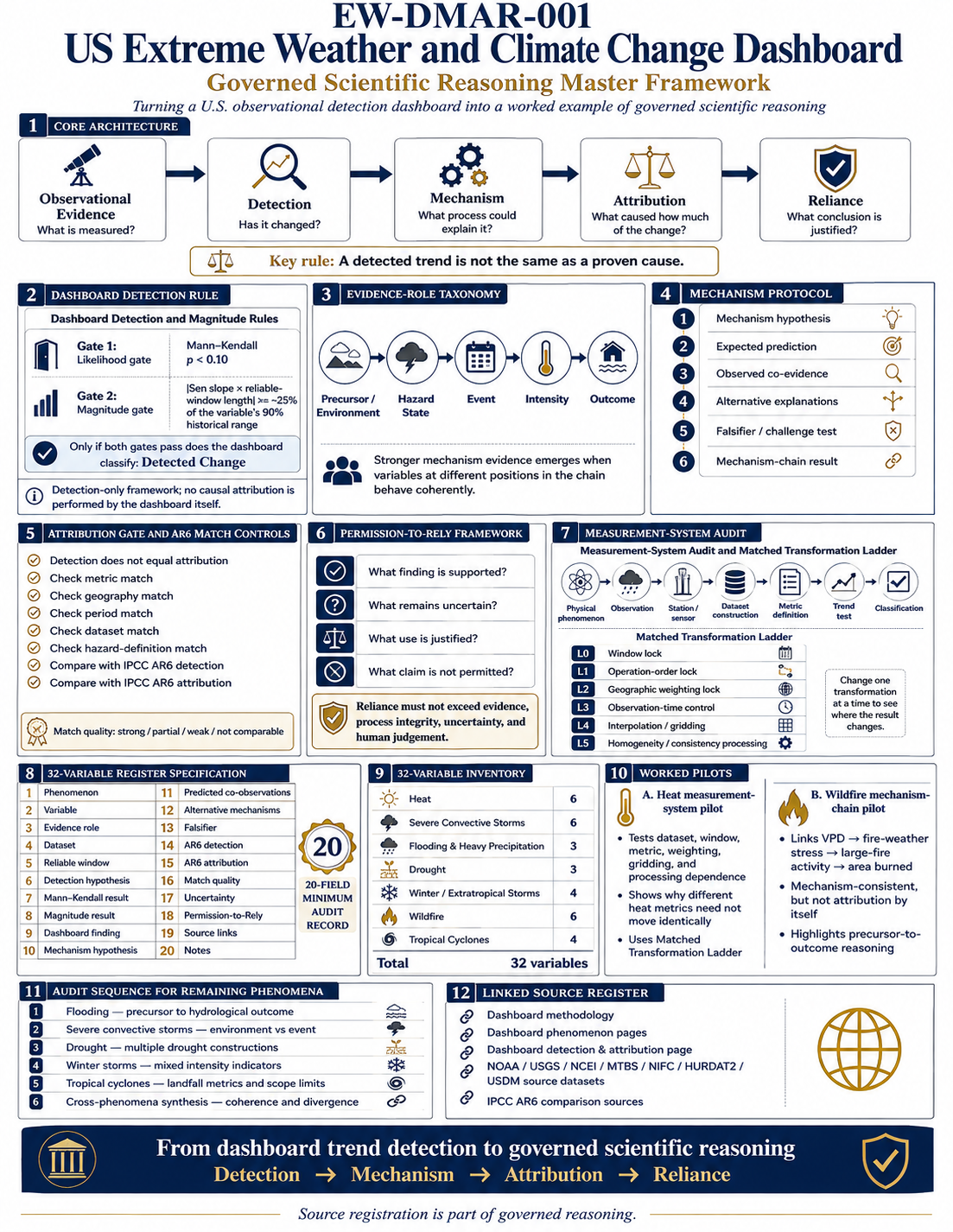 EW-DMAR-001 · Governed Scientific Reasoning Master Framework
 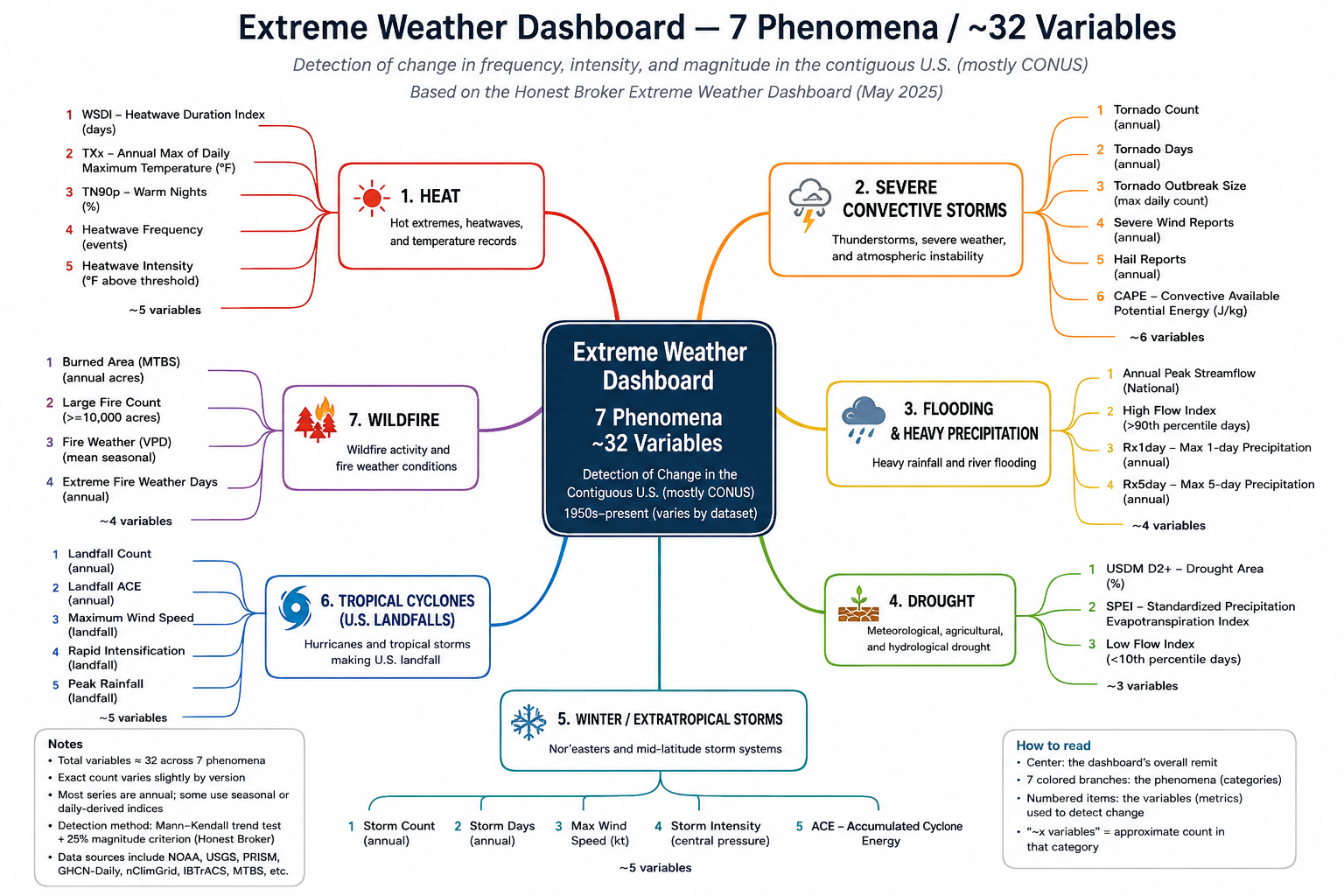 Extreme Weather Dashboard · Seven Phenomena and Approximately 32 Variables
 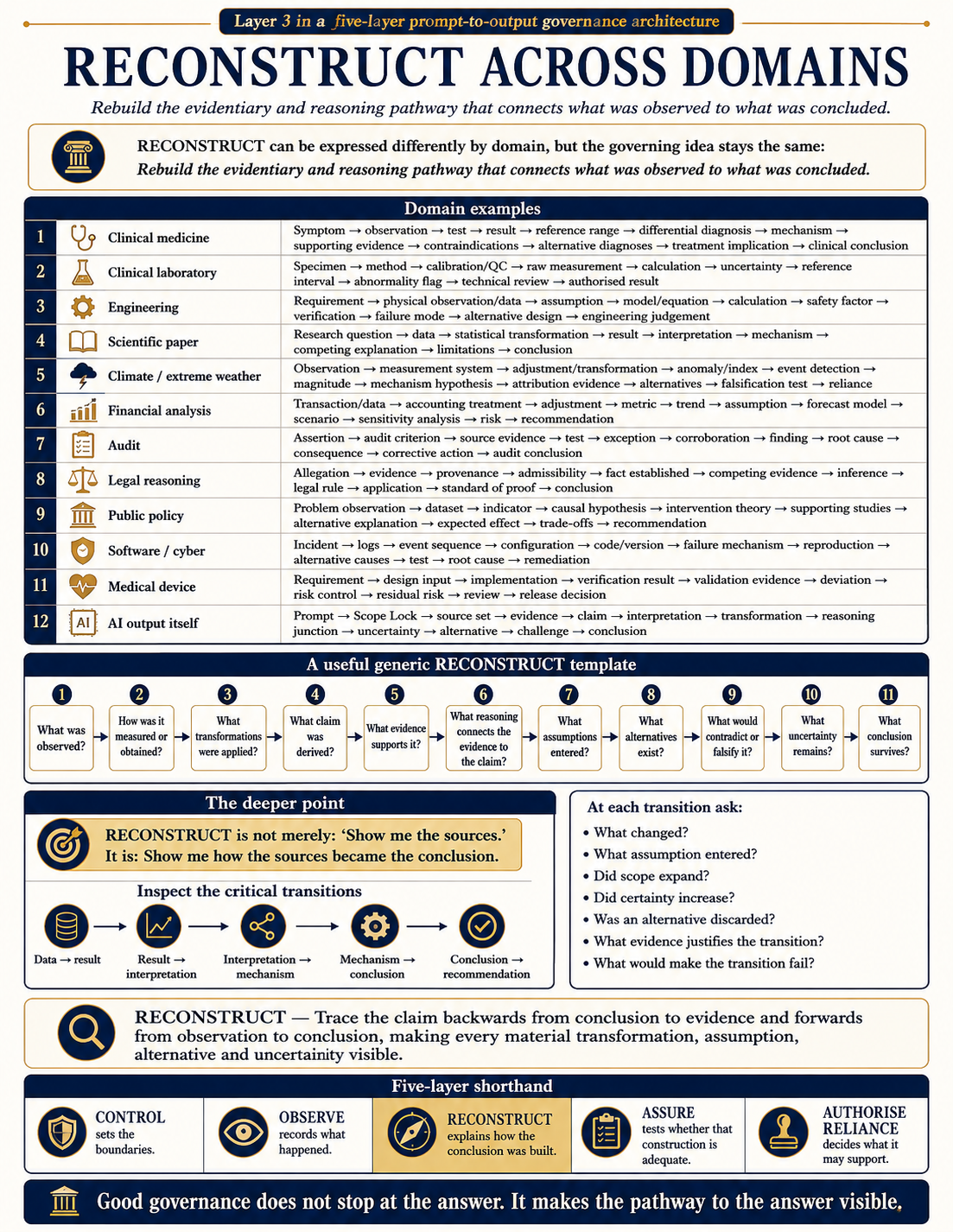 Reconstruct Across Domains
 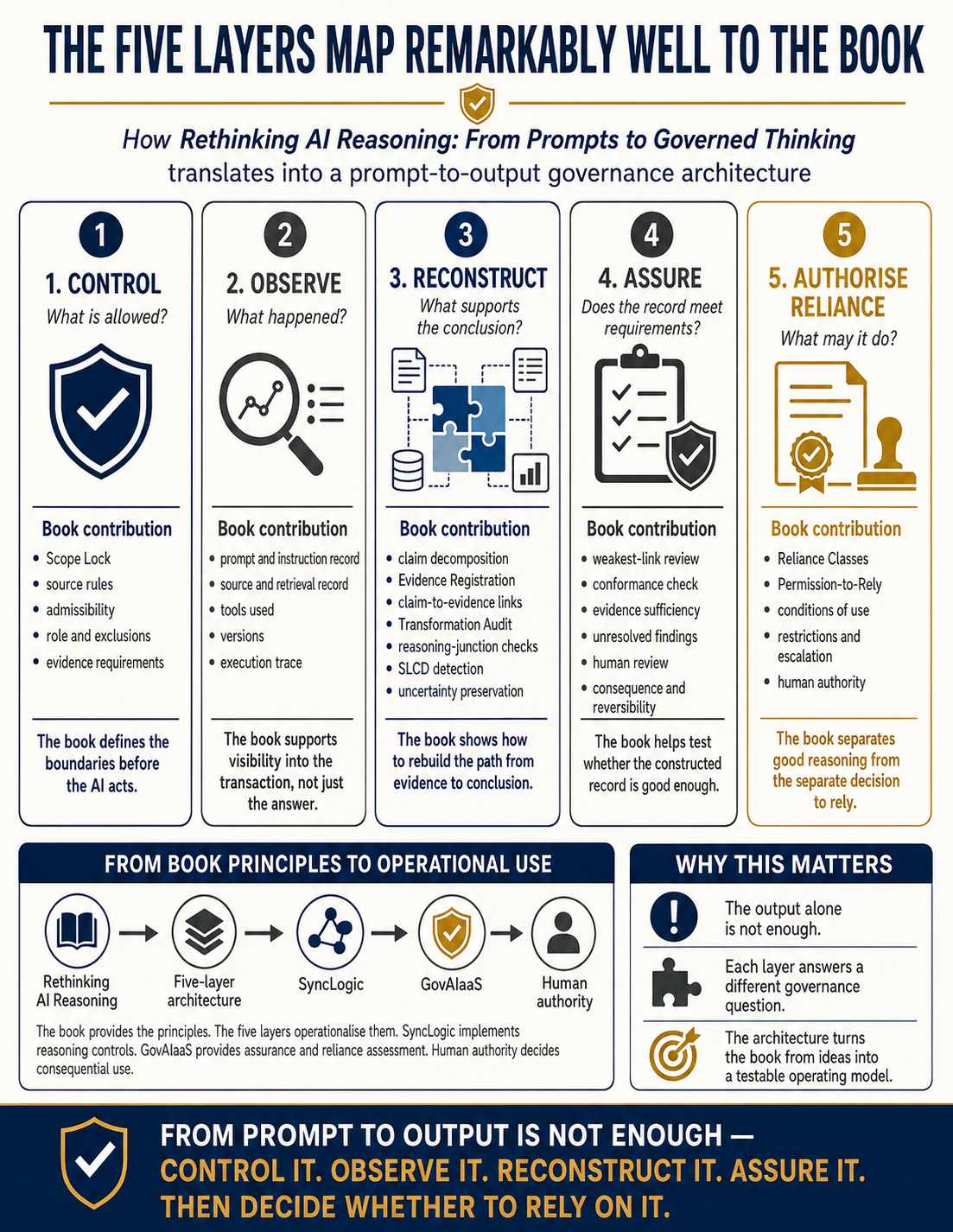 The Five Layers Map to the Book
 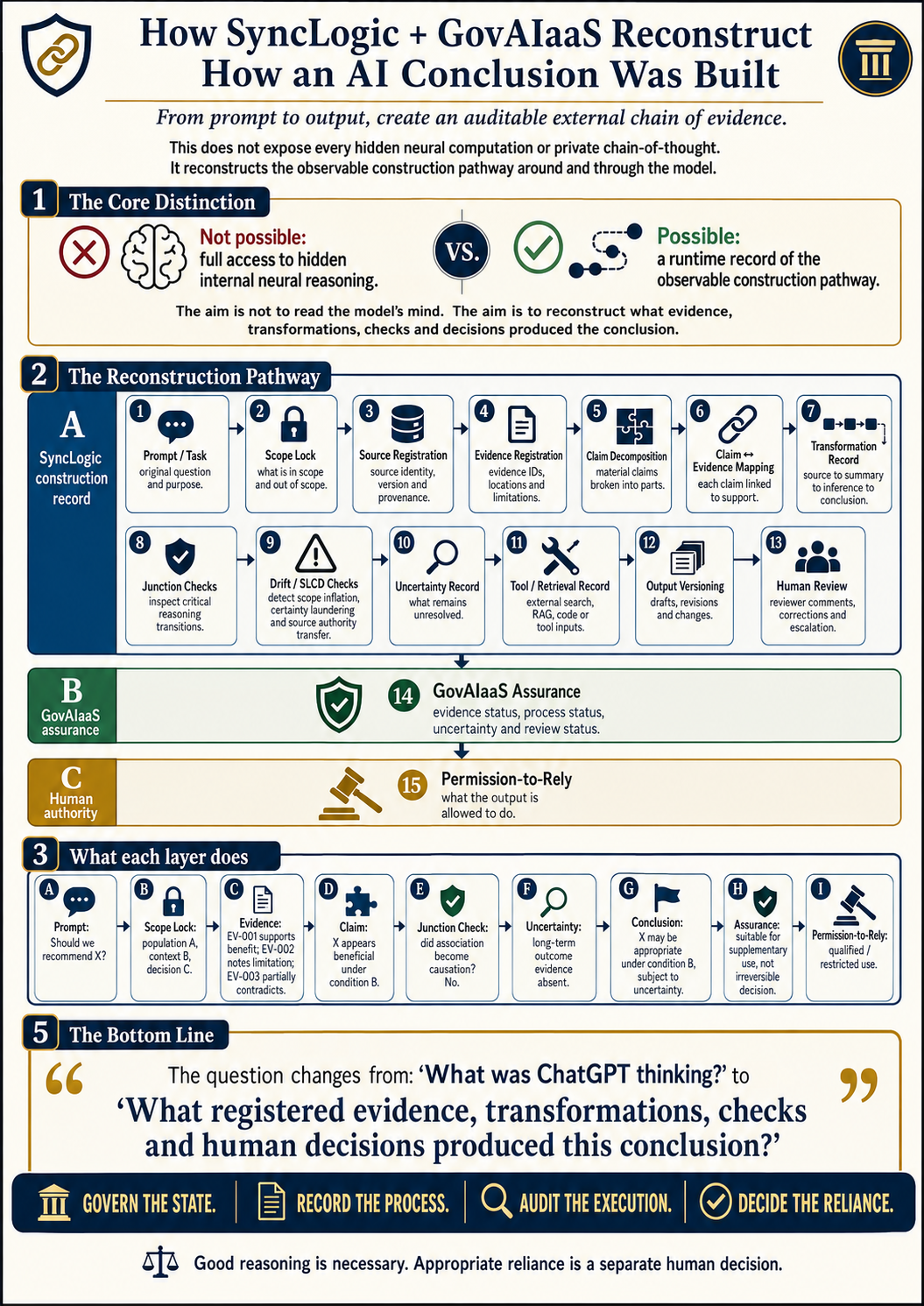 How SyncLogic and GovAIaaS Reconstruct an AI Conclusion
 Select an artwork to view it at full size.
Set 4
Demonstrating the architecture on substantive evidence, claims, uncertainty and contested reasoning.
Explore this stageThe five-layer architecture
The target is not hidden neural computation or private chain-of-thought. It is an auditable, external evidential process record.
What is allowed?
Guardrails, scope, permissions and admissibility.
What happened?
Execution trace, retrievals, tools, events and outputs.
What supports the conclusion?
Sources, evidence, claims, assumptions, transformations, reasoning junctions and uncertainty.
Does the record meet requirements?
Evidence sufficiency, process conformance, findings, review and consequence.
What may the conclusion support?
Reliance conditions, restrictions, escalation and human authority.
What a governed transaction leaves behind
The architecture becomes tangible when it produces inspectable records, not merely a diagram or an output.
Runtime technical evidence
Tools, retrievals, events, system actions and generated outputs.
Transaction-level assurance object
The sources, claims, evidence, transformations, uncertainty, review and reliance conditions around the conclusion.
Core components
The key distinction
Technical observability can show what the AI system did. The next questions concern evidential support, assurance and permitted use.
Observe
Reconstruct
Assure
Authorise
Does the recorded evidence support what the conclusion says?
Given the consequence of being wrong, what is that conclusion permitted to support?
Proposed evidential-record classification
The six PR classes identify how a record came into existence and how much mediation separates it from the transaction under review. As the number rises, the record generally moves further from direct capture — but rank alone does not establish truth, integrity or fitness for use.
Reviewed position: coherent as a proposed classification; not an established standard.
Created during, or immediately adjacent to, the event or transaction it records.
Examples: System event log, timestamped ledger entry, real-time sensor reading or transaction receipt.
Most direct provenance; still requires integrity, relevance and completeness checks.
Original material that already existed and was later retrieved, restored or extracted from storage, backups, archives or residual media.
Examples: Recovered log file, archive export, restored backup or faithful forensic copy.
High direct evidential status, subject to the recovery method, chain of custody, completeness and selection.
A pathway, sequence or state rebuilt from surviving fragments through documented methods and intermediate steps.
Examples: A transaction flow assembled from several logs or an event sequence rebuilt from forensic artefacts.
Potentially strong, but it is not the original trace and must expose gaps, assumptions and alternatives.
A claim derived by reasoning from available evidence rather than directly observed or recovered.
Examples: Logical deduction, statistical association, domain interpretation or a pattern-based conclusion.
Its weight depends on the evidence, assumptions, method, uncertainty and competing explanations.
An after-the-fact narrative, summary, justification or causal account produced by a person or AI system.
Examples: Analyst explanation, model rationale, generated summary or post-hoc causal narrative.
Useful for communication or hypothesis formation; the explanation itself is not direct evidence of the event.
An artefact that demonstrates, transfers or evaluates a capability rather than documenting the specific transaction under review.
Examples: Prompt template, trained model, simulation, synthetic example or transferred skill artefact.
May evidence capability or performance, but not the historical path of a particular conclusion.
Reviewed position
A lower PR number ordinarily means less mediation between the record and the event. It does not guarantee accuracy. Reliance must also consider integrity, completeness, relevance, corroboration, uncertainty, chain of custody and human review.
Tag each supporting element with its PR class, then set evidential weight and verification requirements proportionately.
Prevent fluent PR-5 explanations or PR-6 demonstrations from being mistaken for PR-1 or PR-2 transaction evidence.
Make the origin, transformations and limitations of every supporting record visible to reviewers.
Practical rule: A reconstructed pathway (PR-3), inferred link (PR-4), generated explanation (PR-5) or capability artefact (PR-6) can be useful, but it must never be represented as a contemporaneous transaction record (PR-1) without evidence establishing that status.
A proposed governance ecosystem
Three distinct roles — connected without collapsing reconstruction, assurance and human authority into one another.
Methodological foundation
Scope Lock, source and evidence registration, claim decomposition, Fork First, Transformation Audit, uncertainty preservation, Reliance Classes and Permission-to-Rely.
rethink-ai-reasoning.infoProposed operational reasoning-control framework
Convert observable AI execution into a structured, auditable external chain of sources, evidence, claims, transformations, junctions and uncertainty.
synclogic.systemsProposed assurance and reliance framework
Evaluate the reconstructed record against defined requirements and support a governed decision about permissible reliance.
govaiaas.comA governance architecture only becomes meaningful when it can operate on real evidence, real claims and real uncertainty.
Bound the task, admissible sources and intended use.
Record retrievals, tools, events and generated outputs.
Map sources to evidence, claims, transformations and uncertainty.
Assess sufficiency, conformance, limitations and review findings.
State permissible reliance, conditions and required human authority.
This demonstrates how the proposed architecture can be applied. It does not, by itself, validate correctness or grant authority to rely.
The standards question
Working hypothesisExisting standards increasingly address governance, risk, lifecycle processes, transparency, explainability, logging and quality. The research question is whether consequential AI also requires a controlled record linking a conclusion to what its evidence and process justify.
Evidence discipline
From conclusion to consequence
When an AI conclusion matters, make its evidence, process, uncertainty and human authority visible before acting upon it.
Make evidence visible. Keep it connected. Decide the reliance you can justify.